
Hip Replacement Recovery: Cold & Compression After Surgery
Published · by Recovery Kit Team
Hip replacement recovery is often described as “easier than a knee” — but the first two weeks still come with real swelling and real pain. Here's what the clinical evidence says about how cold and compression can help.
A total hip replacement (also called a total hip arthroplasty, or THA) is one of the most life-changing operations modern medicine can offer. Patients who could barely walk before surgery are often back to short walks within days. But the first two weeks still involve significant swelling around the thigh and groin, deep ache from the surgical site, and the cautious early steps that determine how the rest of recovery goes.
Cold and compression therapy is a well-established tool for the early hip recovery window — and the contemporary clinical evidence increasingly supports its use, particularly when delivered by a controlled device rather than improvised ice packs. Below, we walk through what the research actually shows for hip patients specifically.
What the research shows for hip patients
The clearest hip-specific trial is a 2019 randomised study by Ito and colleagues, which followed 60 patients after a total hip replacement. Half received continuous local cold therapy; half received standard care. By day 4, thigh circumference (a direct measure of post-operative swelling) was significantly lower in the cold-therapy group. Patient-reported satisfaction with walking was also significantly higher at days 4 and 7 — patients felt more confident on their feet sooner.
The broader picture comes from the 2024 Liang meta-analysis (Orthopaedic Surgery), which pooled 21 trials and 1,462 patients — including a hip-replacement subgroup of 285. Cold therapy reduced pain scores on the first two post-operative days. The effect amplified when active intermittent compression was added.
↓ Thigh swelling
Day-4 thigh circumference significantly lower with continuous local cold therapy vs control (Ito 2019, n=60).
↑ Walking confidence
Significantly higher patient-reported satisfaction with walking at post-op days 4 and 7 (Ito 2019).
↓ Pain
Reduced VAS pain across the first two post-operative days in the hip-replacement subgroup (Liang 2024 meta-analysis).
↑ Comfort at home
Patient satisfaction scores consistently higher with controlled cold-and-compression devices than with ice packs.
Why the hip is a slightly different problem
Knee swelling is mostly inside the joint — a tense, hot capsule full of fluid. Hip swelling is different: most of the visible swelling sits in the soft tissue around the joint, often spreading down the thigh and sometimes into the groin. That makes the goal a bit different too: instead of cooling a single accessible joint, you're trying to cool and compress a large area of soft-tissue swelling.
That's exactly the case the Ito 2019 trial was making — and it's why the thigh circumference measurement is the most telling outcome. Reducing the size of that swelling helps with three things at once: it's less uncomfortable, you can move more easily, and the mechanical restriction on early walking is reduced.
Compression is particularly useful here. Cold alone slows the inflammatory response and dulls pain. Active intermittent compression mechanically helps fluid move out of the soft tissue and back into the lymphatic system, where the body clears it — which is why the combined approach tends to outperform either alone.
What this looks like day by day
A typical pattern for our hip-replacement customers:
- Day 0–3. Frequent sessions — 20–30 minutes at a time, several times a day, with breaks for physio, meals, and walking. This is the window where the day-4 thigh-swelling result was won in the clinical trial.
- Days 4–7.Sessions tied to your walks and physio. Cooling after activity helps prevent the “evening swelling” flare-up that knocks confidence the next morning.
- Weeks 2–3. As-needed. The deep ache and tightness usually ease through this window, and most customers naturally taper their use as the swelling resolves.
As with knees, the long-term outcomes (at three months and beyond) tend to converge between patients who use cold and compression and those who don't. The value isn't a different endpoint — it's a smoother early curve, less pain in the first two weeks, and more confidence in those first walks. That's often what determines whether someone stays mobilised and active early, which itself is the strongest predictor of a good recovery.
Is it safe after a hip replacement?
Yes — no safety signal has been reported in any of the meta-analyses, including in the hip subgroups. The NICE1 holds skin temperature in the 10–15°C range that the contemporary literature identifies as the therapeutic window, applies compression on a fixed intermittent cycle, and is specifically designed to avoid the failure modes (direct ice on skin, prolonged unbroken cooling under a tight wrap) that drove the very rare adverse events reported in older studies.
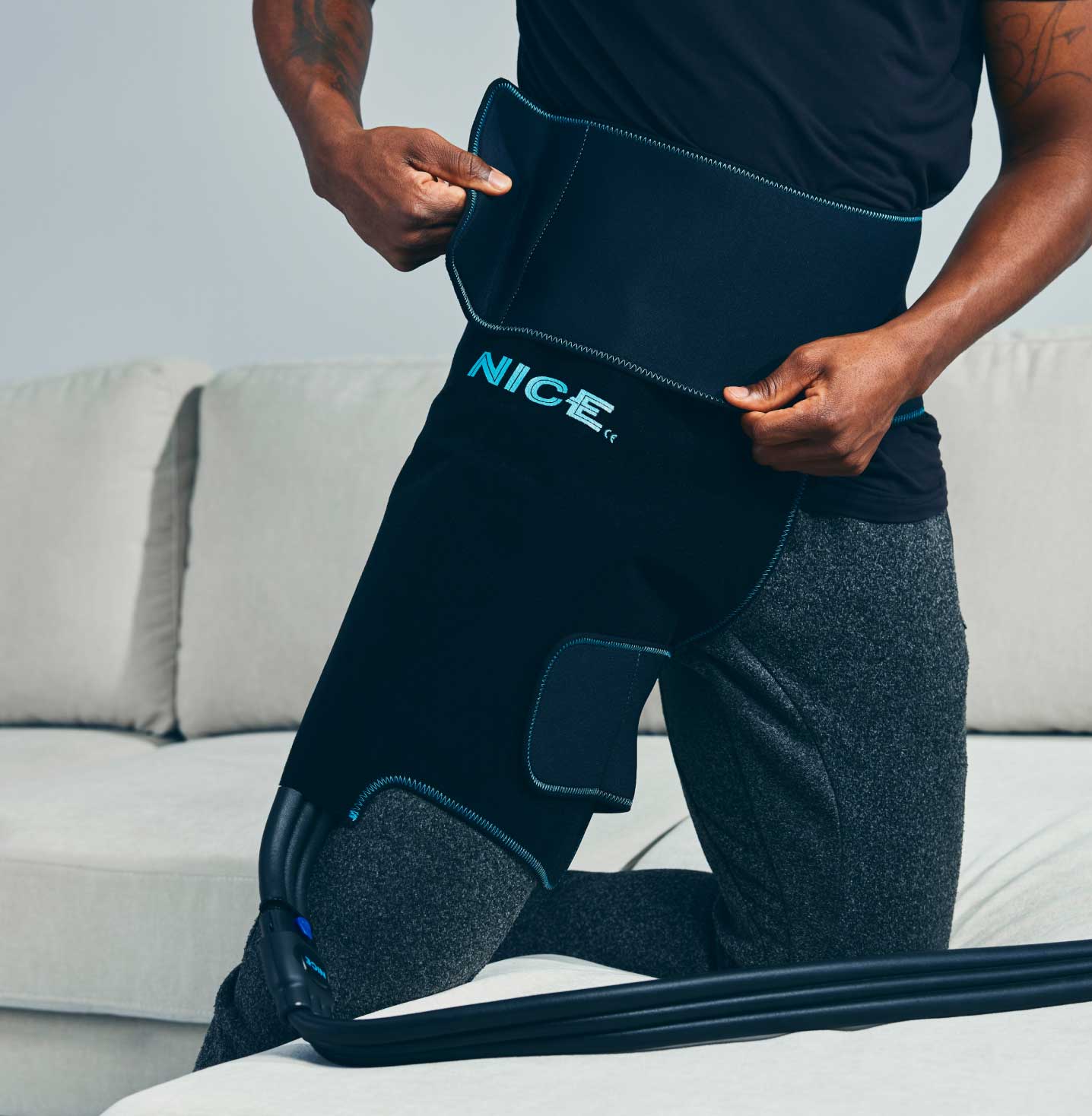
Two practical considerations for hip patients in particular: the wrap is shaped to fit around the hip rather than the knee, so make sure you've got the right size; and confirm with your surgical team that they're happy with cold and compression alongside any compression stockings or anticoagulants you've been prescribed. Most teams are.
Where the NICE1 fits
The NICE1 is a portable, patient-controlled cold and compression machine designed for exactly this window. We supply it with a hip-specific wrap that's shaped to fit around the surgical site without pressing on the operative scar. It's small enough to use anywhere in the house and runs on water rather than needing ice — which matters when you're still moving cautiously and don't want to be wrestling freezer packs.
Cold and compression sits alongside whatever else your team has prescribed — pain relief, anticoagulants, physiotherapy, walking. It's an adjunct, not a replacement. But for the first two to three weeks after a hip replacement, the evidence and our customers' experience both point in the same direction: it makes the early window noticeably more manageable.
Recovering from a hip replacement?
References & further reading
- Ito et al. — Continuous local cryotherapy following total hip arthroplasty, 2019.
- Liang J et al. — Cryotherapy for rehabilitation: systematic review and meta-analysis. Orthopaedic Surgery, 2024.
- Recovery Kit — Your cold and compression surgery recovery guide.
- Recovery Kit — I've got a lower limb injury: should I be doing cold and compression therapy?