
Knee Replacement Recovery: What the Science Says About Cold & Compression
Published · by Recovery Kit Team
The first three weeks after a total knee replacement do most of the work. Here's what the latest research says about how cold and compression therapy can help you get there faster, with less pain and less swelling.
A total knee replacement (also called a total knee arthroplasty, or TKA) is one of the most successful operations in modern medicine — but the first few weeks of recovery are demanding. Pain, swelling, and a stiff knee that won't straighten or bend are the three challenges almost every patient meets. They're also the three things that cold and compression therapy is designed to target.
Cold therapy has been part of post-surgical recovery for decades — but the science has moved on. The contemporary clinical literature now points clearly to one approach: cold combined with active intermittent compression, delivered by a controlled device, in the first few days and weeks after surgery. Below, we walk through what that research actually shows and what it means for your recovery.
What the research shows
The strongest single source is a 2024 systematic review and meta-analysis by Liang and colleagues (Orthopaedic Surgery), which pooled 21 randomised controlled trials and 1,462 patients — 1,177 of them total knee replacements. They looked at how cold therapy compared to standard care without it. Across the first three days after surgery, cold therapy reduced average pain scores (measured on the 0–10 Visual Analogue Scale) by 0.6–0.9 points compared with no cold therapy. That doesn't sound like a huge number — but it's consistent, reproducible across trials, and adds up over the dozens of times you'd otherwise reach for a painkiller.
More importantly, the effect amplifies when compression is added. This is the headline finding from the modern evidence base — and it's the difference between a bag of ice and a clinically engineered cold-and-compression device.
↑ Range of motion
Significantly better knee extension at day 1 and day 14 with cryocompression vs ice + static compression (Marinova 2023, n=72).
↓ Swelling
Significantly reduced joint effusion at day 21 with compressive cryotherapy vs standard cold alone (BMC Musculoskeletal Disorders, 2024).
↑ Function
Higher KOOS scores and a faster 6-minute walk test at day 21 with compressive cryotherapy (BMC 2024).
↓ Pain
Mean VAS reduction of 0.6–0.9 points across post-op days 1–3 (Liang 2024 meta-analysis of 21 RCTs, 1,462 patients).
Why compression makes the difference
The cleanest test of the “does compression add to cold?” question comes from a 2023 randomised trial by Marinova and colleagues (KSSTA). Seventy-two patients having a total knee replacement were split between a cryocompression device (cold plus active intermittent compression) and traditional ice packs with static bandaging. The cryocompression group had significantly better knee extension at both day 1 and day 14 — the early window where range of motion gains matter most for getting back to walking.
The 2024 BMC Musculoskeletal Disorders trial backed this up over a longer window. Forty patients were split between compressive cryotherapy and standard cold therapy. At day 21, the compression group scored significantly higher on the Knee Osteoarthritis Outcome Score (KOOS), walked further in the 6-minute walk test, and had measurably less fluid in the knee joint.
The reason this works is straightforward. Cold dampens pain signals and slows the inflammatory cascade. Compression mechanically pushes fluid out of the joint and back into the lymphatic system, where the body can clear it. Used together, each amplifies the other — and the cryocompression cuff also keeps the cold pad in firm contact with the skin, so the cooling effect reaches further into the tissue.
What this looks like day by day
Most patients we work with follow a simple pattern that aligns with the protocols used in the clinical trials:
- First 48–72 hours. Continuous or near-continuous use, with breaks for physiotherapy and meals. This is the acute window where swelling is worst and where the evidence for pain reduction is strongest.
- Week 1.Several sessions per day, especially after physiotherapy. Cooling and compression after exercises helps stop the “flare-up” that can otherwise set recovery back.
- Weeks 2–3. As needed — after physio, after walks, or any time the knee feels hot or swollen. The day-21 functional gains in the BMC 2024 trial were won during this window.
One nuance worth knowing: the long-term outcomes in these trials (at six weeks and beyond) tend to converge — patients in both groups eventually reach a similar range of motion and function. So the value of cold and compression therapy isn't about a different destination. It's about getting there faster, more comfortably, and with a smoother early curve. That matters when you're the one navigating it.
Is it safe?
Yes — and that's consistent across the meta-analytic literature. No safety signal has been reported in any meta-analysis of cold-and-compression devices used after knee replacement. The very rare nerve or skin injuries reported in older studies were almost all linked to ice held directly against the skin under a tight wrap for too long — a failure mode that modern devices like the NICE1 are designed to avoid through stable temperature control (held in the validated 10–15°C therapeutic window) and intermittent compression cycles.
Standard precautions apply: confirm with your surgical team before starting, check your skin and sensation regularly during continuous use, and let us know if you have any conditions affecting circulation or cold sensitivity (Raynaud's, cold urticaria, peripheral vascular disease).
Where the NICE1 fits
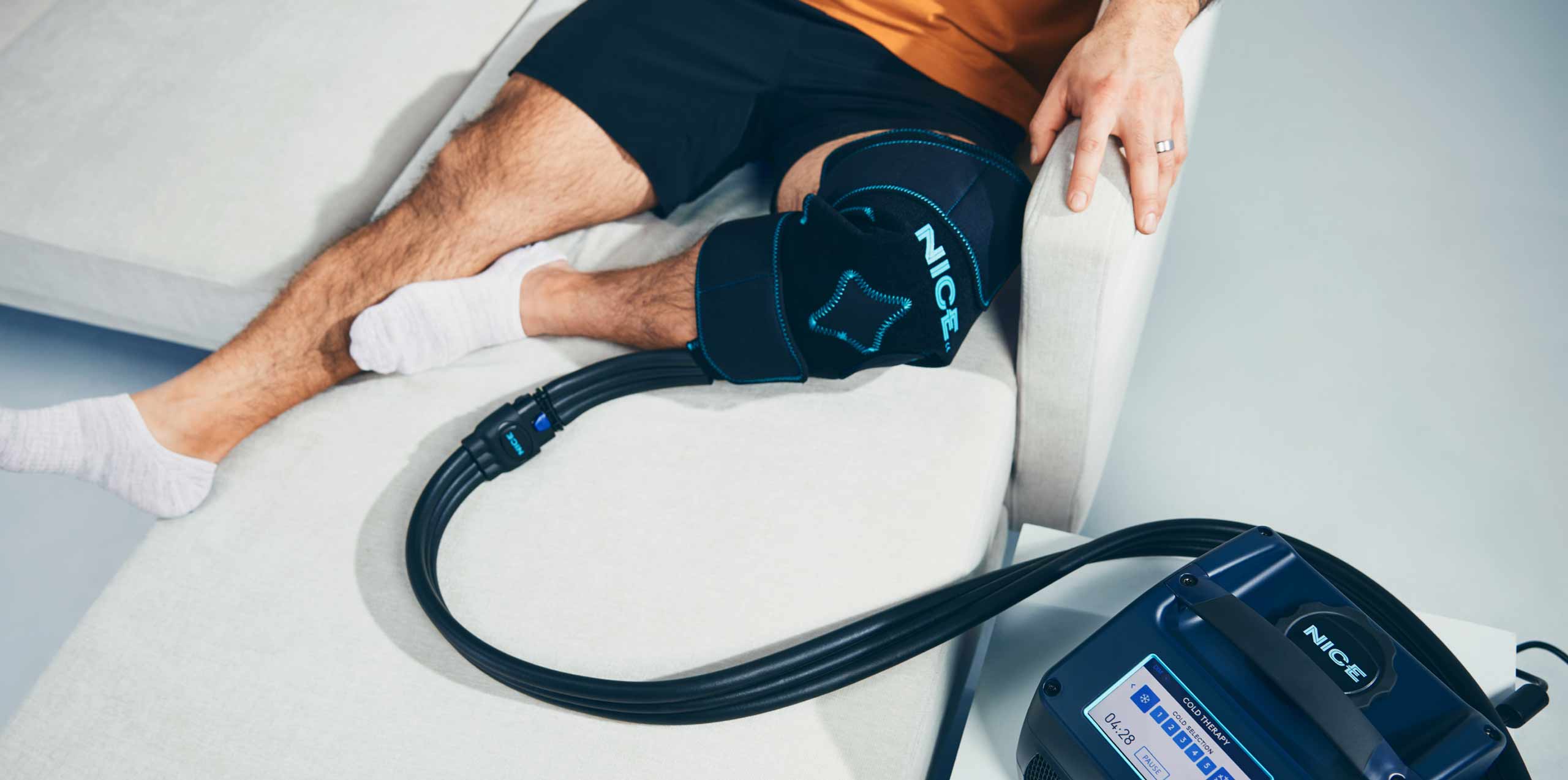
The NICE1 is a portable, patient-controlled cold and compression device built for exactly this window. It holds skin temperature in the 10–15°C range that the contemporary literature identifies as the therapeutic sweet spot, delivers active intermittent compression on a fixed cycle, and is small enough to use at home — which matters, because the evidence shows the day-7 to day-21 gains are won afterdischarge, when the hospital's ice machine is no longer available.
It also sits comfortably alongside whatever else your surgical team has prescribed — paracetamol, anti-inflammatories, short-course opioids, and physiotherapy. Cold and compression is an adjunct, not a replacement. But the research is clear that it's one of the most evidence-backed non-drug tools available for managing the first three weeks after a knee replacement.
Recovering from a knee replacement?
References & further reading
- Liang J et al. — Cryotherapy for rehabilitation after total knee arthroplasty: a comprehensive systematic review and meta-analysis. Orthopaedic Surgery, 2024.
- Marinova V et al. — The role of a cryocompression device following total knee arthroplasty. KSSTA, 2023.
- Compressive cryotherapy vs standard cryotherapy after total knee arthroplasty. BMC Musculoskeletal Disorders, 2024.
- Su EP et al. — Cryopneumatic device on total knee arthroplasty recovery. Bone & Joint Journal, 2012.
- Recovery Kit — Using Compex after knee replacement surgery
- Recovery Kit — How Cold Should I Be? A guide to the optimal temperature range.
- Recovery Kit — Your cold and compression surgery recovery guide.