
Cryocompression vs Ice Packs: What's the Difference?
Published · by Recovery Kit Team
Ice in a tea towel. A cold pack from the freezer. A “cold therapy machine”. Cryocompression. They all do the same thing, right? Not quite — and the difference matters more than you'd think.
For decades, “ice it” has been the default first step after an injury or operation. And it works — to a point. But the technology that delivers cold therapy has moved on considerably, and the modern clinical evidence is quite clear about which approach produces the best outcomes. This is a short guide to what's actually different between the options, and what the research says about each.
Option 1: ice packs
A reusable gel pack from the freezer, crushed ice in a towel, or a bag of frozen peas. This is what most patients are sent home with, and it's genuinely better than nothing.
The limitations are practical and physical:
- The temperature is wrong at both ends. Straight from the freezer, an ice pack is around −18°C — well below the safe therapeutic range, and a cold-burn risk if held against bare skin. Within 10–15 minutes, the pack has warmed past the useful range and is doing very little.
- It can't hold a consistent temperature. The whole point of cold therapy is sustained cooling. An ice pack starts too cold, then steadily warms — which is the opposite of what the tissue needs.
- It needs constant rotation.20 minutes on, freezer, 20 minutes on, freezer. If you're recovering from major surgery, getting up to swap packs every half hour is exhausting at exactly the wrong time.
- No compression.An ice pack just sits there. It doesn't help fluid move out of the swollen tissue.
Across the contemporary clinical literature, ice packs are the comparator most other approaches are measured against — and they consistently come out behind on patient satisfaction, range of motion, and the time it takes to clear swelling.
Option 2: continuous cold-flow machines
The next step up — machines like the Cryo-Cuff or Polar Care. Iced water is circulated from a cooler through a pad wrapped around the joint. The cold stays consistent (a clear improvement on ice packs), and you don't have to swap packs every 20 minutes.
What's missing is compression. The pad is held in place with a static wrap, but there's no active pumping — nothing mechanically helps fluid move out of the swollen area. In head-to-head meta-analyses, continuous cold-flow devices are roughly equivalent to ice packs for pain reduction, but trail cryocompression on range of motion and swelling outcomes.
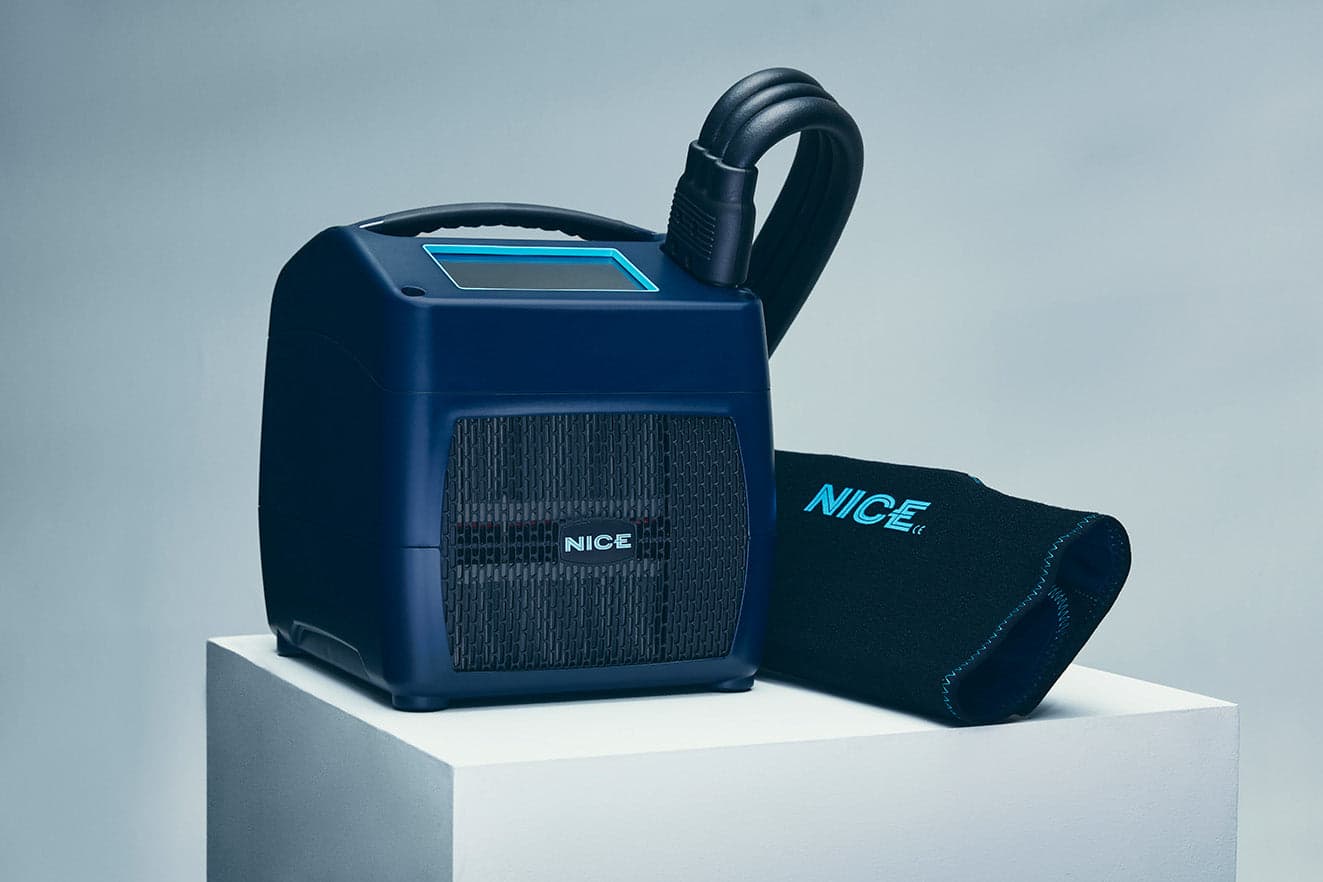
Option 3: cryocompression (the NICE1)
Cryocompression devices like the NICE1 do two things at once. Cold water circulates through a pad held against the surgical site at a clinically validated 10–15°C — the temperature range the literature identifies as the therapeutic window. And the wrap pneumatically inflates and deflates on a fixed cycle, actively pumping fluid out of the swollen area and back into the lymphatic system.
This is the differentiator. The 2023 Marinova trial (KSSTA) compared a cryocompression device head-to-head against ice packs with static compression in 72 knee-replacement patients. Knee extension at day 1 and day 14 was significantly better in the cryocompression group. The 2024 BMC Musculoskeletal Disorders trial compared compressive cryotherapy against standard cold therapy (no compression) in 40 patients: at day 21, the compression group scored significantly higher on the KOOS functional score, walked further in the 6-minute walk test, and had less fluid in the joint.
A 2024 three-arm trial in Arthroplasty compared mobile cold-compression devices, continuous cold-flow devices, and traditional ice packs. The mobile cold-compression arm produced the best early pain reduction and the highest patient satisfaction.
Side-by-side
| Approach | Cooling | Compression | Best evidence |
|---|---|---|---|
| Ice packs | Starts too cold, warms within 15 min | None (static wrap only) | Better than nothing |
| Continuous cold-flow | Steady, but no active pumping | Static wrap only | Improvement on ice; trails cryocompression |
| Cryocompression (NICE1) | Held at 10–15°C, sustained | Active intermittent pumping | Modern standard — strongest RCT evidence |
Why temperature precision matters
One of the less-discussed advantages of a controlled device is what it doesn't do. Most of the rare adverse events reported in older cold-therapy studies — superficial cold burns, occasional nerve irritation — happened with direct ice-on-skin contact, often held in place under a tight wrap for too long.
A cryocompression device like the NICE1 simply can't do this. The cold water is held in the 10–15°C therapeutic range, never anywhere near the freezing temperatures that cause cold burns. The compression cycle is intermittent rather than continuous, so the tissue isn't under unbroken pressure. And the dosing is the same for every patient, every time — not subject to the “I forgot to take it off” variations that affect ice rotation in real life.
The safety profile of cold + compression therapy across the modern meta-analyses is excellent — no safety signal in any pooled analysis. The device-class advantages of cryocompression over improvised ice are themselves safety improvements.
What this means in practice
If you're recovering at home from a soft-tissue injury that'll heal in a week or two, an ice pack is fine — frustrating, but fine. If you're recovering from a major operation like a knee or hip replacement, an ACL reconstruction, or a shoulder repair, the early window matters enormously. The 21-day functional gains the research highlights are won during the first three weeks — and they're won more reliably with a controlled device that combines cold and compression than with ice rotation alone.
That's what we built the NICE1 service around: a portable, easy-to-use cryocompression machine you can hire for the period you need it, with the right wrap for your surgical site and free next-day delivery. It costs less than a few private physiotherapy sessions and gives you the modern-standard tool the clinical literature now points to as the most evidence-backed non-drug option for managing the first few weeks.
Looking for proper cold therapy?
References & further reading
- Marinova V et al. — The role of a cryocompression device following total knee arthroplasty. KSSTA, 2023.
- Compressive cryotherapy vs standard cryotherapy after total knee arthroplasty. BMC Musculoskeletal Disorders, 2024.
- Three-arm RCT of cryotherapy techniques after TKA. Arthroplasty, 2024.
- Recovery Kit — How does the NICE machine actually work?
- Recovery Kit — How cold should I be? A guide to the optimal temperature range.