
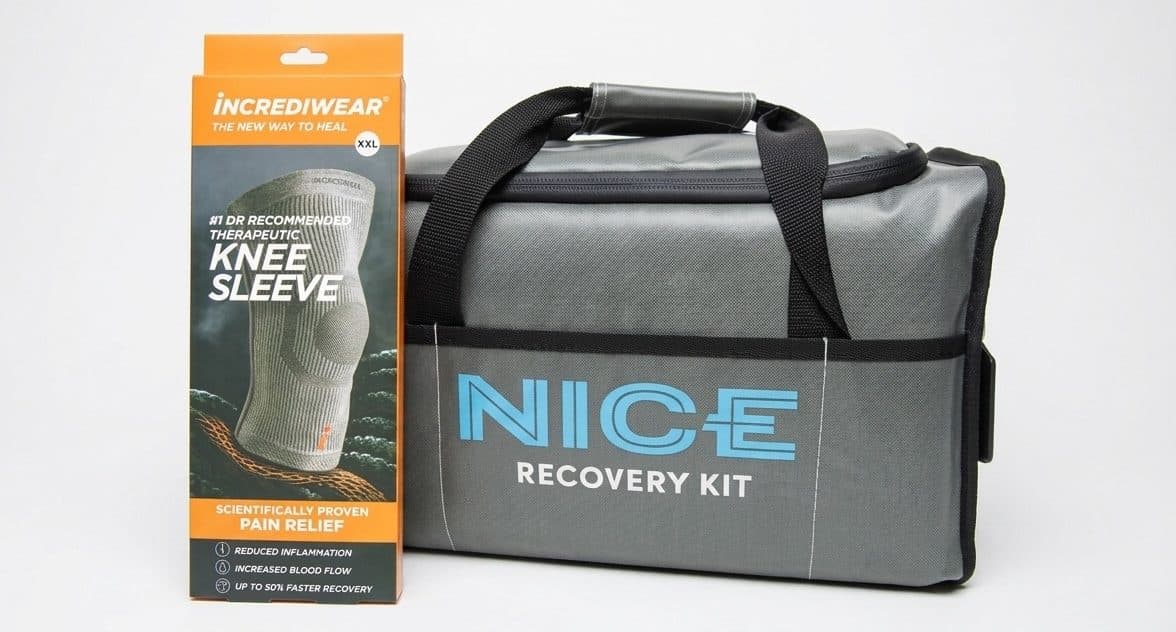
NICE1 + Incrediwear: Two Technologies, One Recovery
Published · by Recovery Kit Team
NICE1 cryocompression and Incrediwear infrared therapy are not alternatives to each other. They work through entirely different biological mechanisms, address different phases of recovery, and used together they cover more of the healing journey than either can alone.
If you are preparing for joint replacement surgery — or already in recovery — there is a good chance you have encountered both cold and compression therapy and wearable recovery garments as part of your protocol. What fewer patients realise is that these two approaches work in completely complementary ways. This post explains how they fit together and what a combined approach looks like in practice.
Two different problems, two different solutions
Post-surgical recovery presents two distinct challenges that evolve over time.
The acute phase— the first days after surgery — is dominated by the body's inflammatory response. Tissue has been disrupted. The immune system floods the area with fluid and immune cells. Swelling peaks. Pain is at its highest. The priority here is controlling that inflammatory cascade before it becomes excessive and starts working against healing rather than for it.
The healing phase — from roughly day four onwards, and extending through the weeks of rehabilitation — is dominated by a different need: getting enough blood flow, oxygen, and nutrients to the healing tissue, clearing inflammatory waste products efficiently, and rebuilding function progressively.
These two phases require different physiological interventions. NICE1 is designed for the first. Incrediwear is designed for the second. Understanding each one makes it easier to see why they work so well together.
How NICE1 works
The NICE1 is a precision cold and compression therapy system designed specifically for post-surgical patients. It circulates temperature-controlled water through an anatomically designed wrap, maintaining a consistent therapeutic temperature of 45–55°F (7–13°C) — the clinically validated range for post-surgical cold therapy.
At this temperature, cold therapy works through two primary mechanisms:
- Vasoconstriction. Cold causes blood vessels in the treated area to narrow, which limits the volume of inflammatory fluid reaching the joint. This is the mechanism by which cold therapy reduces acute swelling and peak inflammation in the immediate post-surgical period.
- Nerve conduction slowing. Cold reduces the speed at which pain signals travel, providing direct analgesic effect — which is why consistent cold therapy in the early recovery period is associated with reduced pain scores and lower opioid requirements.
The compression element of NICE1 supports lymphatic drainage mechanically — the pressure helps the body's lymphatic vessels move excess fluid away from the joint more efficiently than elevation alone.
Together, cold and compression address the acute inflammatory phase with precision. The NICE1's advantage over ice packs is consistency: it maintains therapeutic temperature throughout a session, can be used safely overnight, and does not fluctuate based on how recently the water was cooled.
How Incrediwear works
Incrediwear works through the opposite mechanism to cold therapy — and that is precisely the point.
Incrediwear garments contain semiconductor elements (Germanium and Carbon) woven into the fabric. When activated by body heat above 20°C, these elements release infrared energy and negative ions into the surrounding tissue. This drives an increase in local blood flow and circulation — confirmed in a direct measurement study using a laser Doppler blood flow monitor, which recorded a 17% increase in measured blood flow in tissue covered by Incrediwear.
Increased circulation means:
- More oxygen and nutrients delivered to healing tissue
- Faster lymphatic clearance of inflammatory by-products
- Support for collagen synthesis, cell growth, and tissue regeneration
- Sustained anti-inflammatory effect through circulatory, rather than thermal, pathways
Where the NICE1 slows the acute inflammatory cascade through cold-induced vasoconstriction, Incrediwear accelerates healing through circulation-driven recovery. These are complementary, not competing, approaches.
Why they work together
Think of recovery as having two gears.
In the first gear — the acute phase — you want the body's initial inflammatory response dampened. Too much swelling too early increases pain, limits the range of motion work your physiotherapist needs you to do, and can delay the entire recovery arc. The NICE1 manages this phase with precision.
In the second gear — the healing and rehabilitation phase — you want circulation maximised. Healing tissue needs a rich blood supply. Lymphatic drainage needs to keep pace with the cellular activity of repair. The physiotherapy exercises your care team prescribes are only effective if the tissue receiving the load is well-oxygenated and mobile. Incrediwear drives this phase.
The transition between these two gears is gradual, not abrupt — which is why both products have a role throughout recovery, not just in their primary phase. In the early days, Incrediwear can be worn between NICE1 sessions, supporting circulation during the gaps in cold therapy. As the acute phase resolves, Incrediwear takes over as the primary daily-wear recovery tool, while the NICE1 remains available for managing flares and post-physiotherapy swelling.
A combined recovery timeline
The following is a general guide to how both products can be used across the post-surgical recovery period. Always follow the specific protocol recommended by your surgical team — this is a framework, not a substitute for clinical advice.
Days 1–3 · Acute phase
The NICE1 is your primary tool. Use it consistently according to your surgeon's protocol — typically multiple sessions per day, including overnight. The goal is controlling peak inflammation and keeping pain manageable between medication doses. Incrediwear can be introduced from day one, worn between NICE1 sessions to maintain gentle circulatory support.
Days 4–14 · Active healing
Physical therapy begins. Swelling should be reducing, though it will still be significant. Continue NICE1 sessions — particularly after physiotherapy, when the joint will be inflamed from exercise. Incrediwear daily wear becomes more important during this phase: wear it during movement, during rest, and overnight to support the circulatory demands of active tissue repair.
Weeks 3–6 · Rehabilitation
NICE1 use reduces to as-needed — after intensive physio sessions or on days when swelling is higher than baseline. Incrediwear is your primary recovery tool, worn throughout the day and night. This is the phase in which the clinical evidence for Incrediwear is strongest: a published study comparing Incrediwear to compression stockings in total knee arthroplasty patients found 19% less swelling and greater range of motion at 21 days in the Incrediwear group.
Weeks 6 and beyond
Most patients are progressing well through rehabilitation by this stage. Incrediwear continues to support the ongoing circulatory needs of healing and strengthening tissue. NICE1 remains available for flare management if needed.
What patients notice
Patients using both tools describe a recovery that feels more consistently managed — less defined by peaks of swelling and pain, more stable from day to day. The NICE1 handles the moments when cold is needed: after physio, after a difficult day, overnight in the acute phase. Incrediwear handles everything in between: the hours of rest, the nights, the quiet periods when healing is happening and circulation needs to be supported without any active intervention.
Neither product replaces the other. Together, they cover the full recovery timeline in a way that either alone cannot.
Set up your combined recovery
Further reading
- Recovery Kit — Incrediwear: the clinical evidence.
- Recovery Kit — How Incrediwear works: the science behind the sleeve.
- Recovery Kit — Knee replacement recovery: what the science says about cold & compression.
- Recovery Kit — Hip replacement recovery: cold & compression after surgery.
- Recovery Kit — Why the Red Roses team doctor trusts the NICE1.
This article is for informational purposes only and does not constitute medical advice. Always follow the post-operative instructions provided by your surgical team.