
The 5 Phases of Cold & Compression Recovery
Published · by Recovery Kit Team
Recovery isn't linear, and your cold therapy shouldn't be either. The right temperature and compression on day 2 is different from week 2 — and week 6 is different again. Here's the map.
One of the most common questions we get is “what setting should I use?” The honest answer is that there isn't a single right setting — there's a progression. Recovery moves through fairly predictable phases, and what your tissue needs changes as it goes. Cooling and compression that are appropriate for the acute swelling of day 2 are too mild by week 4. Settings that work for late rehab would be overkill on day 1.
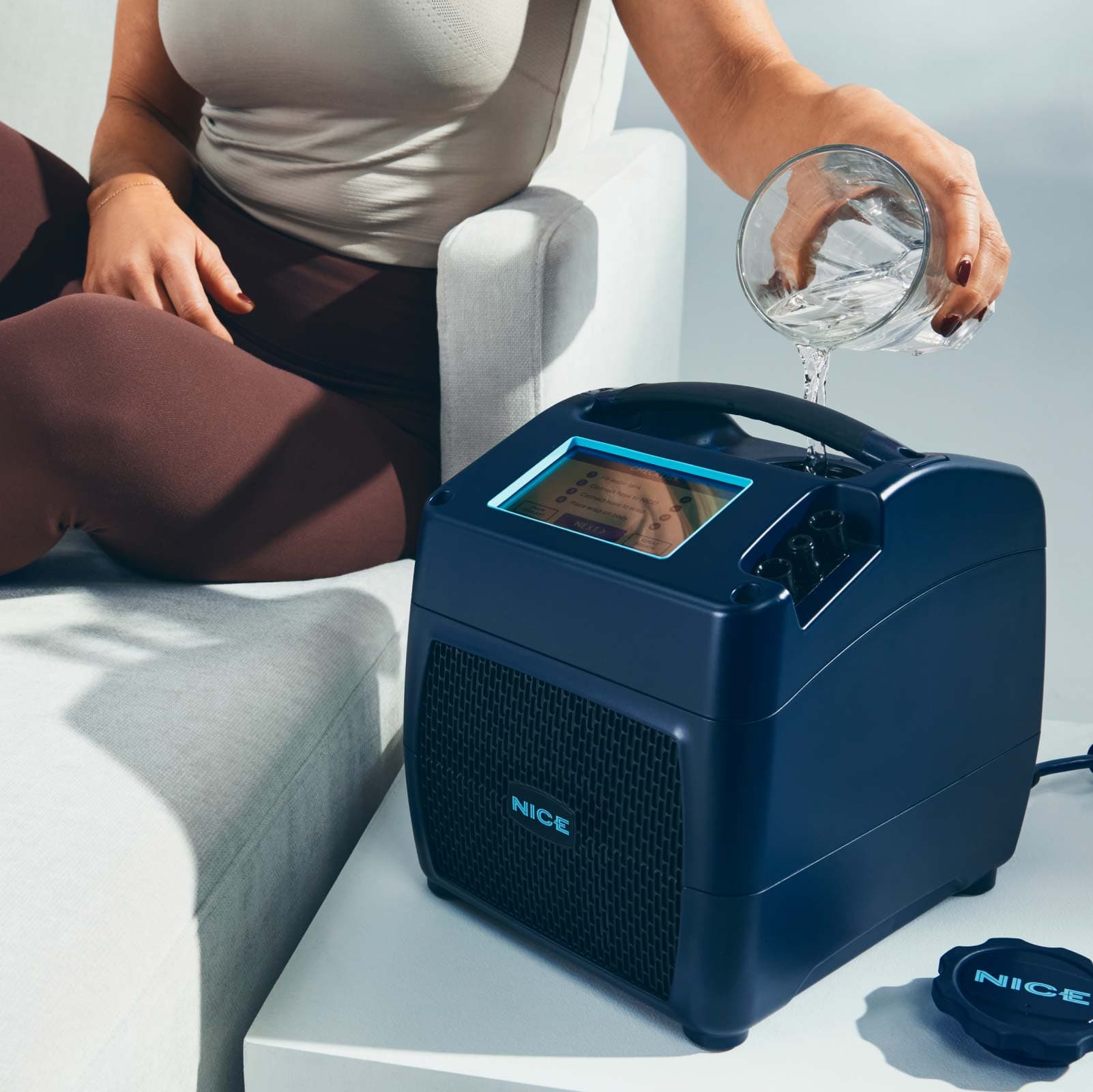
Below is a five-phase framework that maps temperature and compression to the stage of recovery you're in. It's drawn from the protocols built into the NICE1 and the clinical literature on what works at each stage. Every recovery is different, so treat this as a guide rather than a prescription — and always defer to your surgical or physiotherapy team for the specifics of your case.
Phase 1 — acute
Roughly: the first 48–72 hours after surgery or injury.
What's happening: inflammation is at its peak. Capillaries are leaking fluid into the surrounding tissue. Pain signals are firing. The tissue is hot, swollen, and very tender.
Settings — Level 1
Around 14°C (58°F). Low compression (13 mmHg). Used near-continuously, with short breaks for physio, meals, and walking.
The instinct in this window is “go as cold as possible.” The research says otherwise. At 14°C you get meaningful pain relief and good blood-flow reduction without the extreme vasoconstriction that risks slowing the body's own healing response. Compression stays light because the tissue is already tense — adding strong pressure to a freshly-operated joint is uncomfortable and can be counterproductive.
Phase 2 — subacute
Roughly: days 3–7.
What's happening:the worst of the acute inflammation is settling. Swelling is still significant. You're starting to mobilise — short walks, gentle physio exercises — and the tissue needs help recovering from each session.
Settings — Level 2
Around 12°C (54°F). Medium compression (26 mmHg). Several sessions per day — especially after physio or walks.
Compression steps up. The tissue can tolerate more pressure now, and active intermittent compression is genuinely doing work — pushing accumulated fluid out of the swollen area and back into circulation. The cooler temperature gets you a more meaningful analgesic effect without crossing into territory that slows tissue repair.
Phase 3 — activity return
Roughly: weeks 2–3.
What's happening:you're moving more, walking further, doing more physio. The joint feels less hostile, but it still flares up if you push it. This is the window where the day-21 functional gains are won (or lost) — and it's the window most people underestimate.
Settings — Level 3
Around 10°C (50°F). Medium compression (26 mmHg). Targeted use — after physio sessions, after long walks, in the evening if there's been a flare.
This is clinically meaningful cooling — the temperature at which the analgesic effect is well established and where the suppression of inflammatory mediators is significant. Use it strategically: not all day, but at the times when you've asked the joint to do more than it wanted to.
Phase 4 — late rehab
Roughly: weeks 4–8.
What's happening:the surgical swelling is largely gone but you're now pushing range of motion and strength. Sessions are harder, you might be returning to sport or running, and the joint “reminds you it's there” after the heavier sessions.
Settings — Level 4
Around 8°C (46°F). High compression (39 mmHg). Used after harder rehab sessions to control flare-ups and accelerate recovery between sessions.
Strong cooling produces a noticeable analgesic effect and substantial inhibition of the inflammatory enzymes that drive post-exercise soreness. High compression flushes the area more aggressively. This is the “athlete recovery” phase — using the same machine you used for the acute window, but for a different job.
Phase 5 — advanced recovery
Roughly: week 8 onwards, or for ongoing maintenance.
What's happening:you're back to most activities and using cold and compression for recovery rather than rehabilitation — managing the load of training, sport, or heavy work days.
Settings — Level 5
Around 6°C (42°F). High compression (39 mmHg). Used as needed for active recovery after sport or training.
At 6°C, sensory nerve conduction slows substantially and the suppression of inflammatory cytokines is at its strongest. Combined with high compression, this is the most aggressive setting — appropriate for genuine athletic recovery in well-healed tissue, but not for fresh surgical sites. Most patients won't spend much time here, and that's the point: this level is a tool, not a destination.
The whole map
| Phase | Temperature | Compression | Stage |
|---|---|---|---|
| Level 1 | 14°C (58°F) | 13 mmHg — low | Acute (48–72h) |
| Level 2 | 12°C (54°F) | 26 mmHg — medium | Subacute (days 3–7) |
| Level 3 | 10°C (50°F) | 26 mmHg — medium | Activity return (wk 2–3) |
| Level 4 | 8°C (46°F) | 39 mmHg — high | Late rehab (wk 4–8) |
| Level 5 | 6°C (42°F) | 39 mmHg — high | Advanced recovery |
When to move up a phase
There's no calendar that fits everyone — listen to the joint instead. The simplest signals are:
- The joint tolerates more pressure.If the current compression level feels comfortable rather than firm, you're probably ready to step up.
- The cold feels less intense.As tissue adapts and swelling reduces, a given temperature feels milder. That's the cue that you can drop a couple of degrees if needed.
- You're reaching for it less often.Once you're only using cold after specific activities (a long walk, a physio session), you've transitioned from treatment to recovery use.
- Your physio agrees. The simplest cross-check. Most are familiar with graduated cold and compression and can tell you whether your tissue is ready.
Equally, there's no harm in dropping back a phase if something flares — a heavy session that aggravated the joint, a longer walk than usual, or just a bad day. The phases are tools to reach for, not boxes to tick.
Why precision matters
The reason this graduated approach works is that cold and compression act on different parts of the recovery process at different intensities. Mild cooling reduces pain perception without slowing tissue repair. Stronger cooling suppresses inflammation but, if held too long or too cold, can impair the very blood flow the tissue needs to heal. Light compression supports lymphatic drainage; firm compression mechanically pumps fluid out — but only once the tissue can tolerate it.
An ice pack from the freezer can't make any of these distinctions. A controlled cryocompression device like the NICE1 can — and that's the whole reason precision matters.
Ready to recover, properly?
Further reading
- Recovery Kit — How cold should I be? A guide to the optimal temperature range.
- Recovery Kit — Your cold and compression surgery recovery guide.
- Recovery Kit — Cryocompression vs ice packs: what's the difference?
- Recovery Kit — How does the NICE machine actually work?
- Recovery Kit — How to fit your NICE1 wrap: shoulder, foot & ankle.