
Crutches, Walking Poles, a Stick or a Frame? Choosing the Right Walking Aid at Each Stage of Recovery
Published · by Recovery Kit Team
The aid you use after knee or hip surgery, and how you move from one to the next, shapes how evenly you walk, how much load goes through the new joint, and whether you pick up a limp that is hard to shake off later.
Most people leave hospital with a frame or two crutches, and a vague instruction to “come off them when you feel ready”. What happens in between matters more than many people realise. This article looks at what the research says about each type of walking aid, where the evidence runs out, and what we see working for patients.
The options at a glance
| Walking aid | How much support | Best suited to | Main drawbacks |
|---|---|---|---|
| Walking frame (Zimmer frame) or rollator | The most. Can take up to your full body weight through the arms | The first days after surgery, people with poor balance, and anyone at high risk of falling | Slow, encourages a stooped posture, and awkward on stairs and in small spaces |
| Two elbow crutches | High. Can take around half your body weight | Non-weight-bearing and early partial weight-bearing after surgery | Tiring on the shoulders and wrists, and both hands are always occupied |
| One crutch or one stick | Low to moderate, on one side only | Short-term use near the end of recovery, or ongoing support for mild arthritis | Supports one side only, which tends to produce an uneven walking pattern |
| Two walking poles | Moderate, evenly on both sides | Moving on from two crutches once cleared for partial weight-bearing, and building up distance | Not suitable for non-weight-bearing, and need a little technique to get right |
Walking frame (Zimmer frame) or rollator
- How much support
- The most. Can take up to your full body weight through the arms
- Best suited to
- The first days after surgery, people with poor balance, and anyone at high risk of falling
- Main drawbacks
- Slow, encourages a stooped posture, and awkward on stairs and in small spaces
Two elbow crutches
- How much support
- High. Can take around half your body weight
- Best suited to
- Non-weight-bearing and early partial weight-bearing after surgery
- Main drawbacks
- Tiring on the shoulders and wrists, and both hands are always occupied
One crutch or one stick
- How much support
- Low to moderate, on one side only
- Best suited to
- Short-term use near the end of recovery, or ongoing support for mild arthritis
- Main drawbacks
- Supports one side only, which tends to produce an uneven walking pattern
Two walking poles
- How much support
- Moderate, evenly on both sides
- Best suited to
- Moving on from two crutches once cleared for partial weight-bearing, and building up distance
- Main drawbacks
- Not suitable for non-weight-bearing, and need a little technique to get right
What the research says
Frames give the most support, but at a cost. In a study comparing walking aids, frames provided the greatest vertical support, up to 100% of body weight, but produced slow walking with a forward-bent posture. People using elbow crutches walked faster, with longer steps and a more upright posture, while the crutches took up to around half their body weight (Melis et al., 1999). That is why most hospitals move patients off a frame and onto crutches as soon as it is safe.
How a crutch is set up affects how symmetrically you walk. In a randomised study of 30 hip replacement patients, crutches set with a straighter elbow allowed more load on the operated side, took less load through the crutch and reduced asymmetries in the walking pattern, compared with crutches set with a more bent elbow (Esposito et al., Gait & Posture). The detail of how an aid is used matters, not just which aid it is.
A single stick or crutch does take load off the joint, if it is in the correct hand. A pilot study of older adults found that a single elbow crutch held on the opposite side reduced the force going through the hip and knee by around 14% in the push-off phase of each step (Universidad de los Andes). Hold a single aid in the hand opposite the painful or operated leg. Held on the same side, much of the benefit is lost.
Nordic-style walking with poles doesn't increase load on a new hip. Researchers measured forces directly inside instrumented hip replacements and found that Nordic walking produced joint loads comparable to ordinary walking. On level ground, one technique reduced them slightly (Palmowski et al., 2021).
NICE recommends considering walking aids for people with knee or hip osteoarthritis (NICE NG226), so the case for using an aid while you wait for surgery, as well as afterwards, is well established.
Where the evidence runs out
There are, as far as we are aware, no large trials directly comparing one crutch with two walking poles after knee or hip replacement. A recent review of Nordic walking after knee replacement reached a similar conclusion: the approach looks promising, but direct studies are still limited and more are needed (Ciszewski et al., Quality in Sport, 2026).
Our recommendation is therefore based on how each aid shares load between the two sides of the body, the studies above, and what we see with our own patients.
What we see in practice
The point in recovery where we see most problems is the move from two crutches to one. A single crutch supports one side of the body only. To make it work, people lean towards it, shorten the step on the operated leg and spend less time standing on it. Done for a few days, that is rarely an issue. Done for weeks, it becomes a habit, and that habit is often the limp people are still trying to get rid of months later.
Two walking poles keep the support even on both sides. Because they are used in the same rhythm as a natural arm swing, they encourage the walking pattern you are trying to get back to: upright, with equal steps and equal time on each leg.
Which aid, when
Every recovery is different, and your surgeon and physio set the plan. As a general guide for lower-limb surgery such as knee replacement, hip replacement or resurfacing, and ACL or MCL reconstruction:
- First days after surgery: a frame or two crutches, as your hospital team advises.
- Non-weight-bearing or early partial weight-bearing: two crutches.
- Cleared for partial weight-bearing and walking more confidently: two walking poles, in place of a single crutch.
- Full weight-bearing and walking evenly: reduce your use of the poles gradually, keeping them for outdoor walks, uneven ground and tired days.
A frame or rollator remains the right choice for anyone with poor balance, a history of falls, or a condition affecting both legs. Walking poles are not a substitute for that level of support.
Getting started with poles
If you are ready to move on from crutches, our guide to using walking poles after surgery covers setting the height, choosing the right tip and the walking patterns to build through. You can also book a session with one of our qualified strength and conditioning coaches to check your technique: get in touch to arrange one.
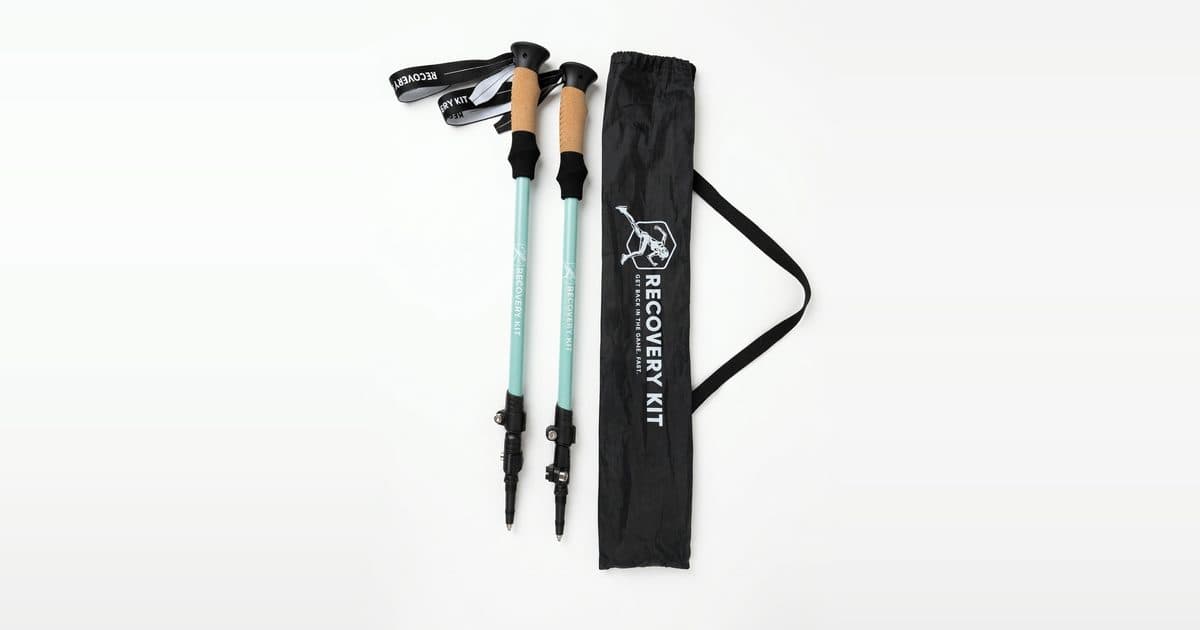
Recovery Walking Poles, designed for the stage between crutches and walking unaided.
This article is general information and is not a substitute for advice from your own surgeon or physiotherapist.
References & further reading
- Melis EH et al. — comparison of walking aids: support, speed and posture. Spinal Cord, 1999.
- Esposito et al. — crutch set-up and gait symmetry after hip replacement. Gait & Posture.
- Universidad de los Andes — single elbow crutch and lower-limb joint forces in older adults (pilot study).
- Palmowski Y et al. — hip joint loading during Nordic walking. Journal of Orthopaedic Surgery and Research, 2021.
- Ciszewski A, Bajko J, Błażewicz J — Nordic walking after total knee arthroplasty: a narrative review. Quality in Sport, 2026.
- NICE — Osteoarthritis in over 16s: diagnosis and management (NG226).