
Knee Replacement Recovery Timeline: What to Expect Week by Week
Published · by Recovery Kit Team
Most of the hard work after a knee replacement happens in the first three months. Knowing what's normal at each stage makes it much easier to keep going.
Recovery from a knee replacement isn't a straight line. Some days you'll feel you've turned a corner, then the knee swells after a longer walk and it feels like a step back. That's normal. Swelling comes up at every stage, and keeping it under control makes a big difference to how each week feels.
This guide walks through what usually happens from the day of surgery to three months and beyond. Every hospital has its own protocol and everyone recovers at a different pace, so treat the timings as a rough guide. If your surgical team or physio has told you something different, follow their advice.
| Stage | What usually happens | Milestones |
|---|---|---|
| Days 1 to 4 | Up and walking with a frame or crutches; compression stockings on | Most people go home within one to four days |
| Weeks 1 to 2 | Pain, swelling and bruising; leg raised, cold and compression, exercises | Stitches or clips out at about ten days; many use one stick or none around the house by week two |
| Weeks 3 to 6 | Longer walks, less stiffness, work on knee bend; swelling after busier days | Follow-up at about six weeks; driving from six weeks (total) if your doctor agrees |
| Weeks 6 to 12 | Back to work and gentle hobbies; still no heavy household jobs | Work at six to twelve weeks; swimming once healed; golf chipping from eight to twelve weeks |
| Three months + | Swelling, warmth and numbness can take longer to settle | Most activities possible between three and six months |
Days 1 to 4
- What usually happens
- Up and walking with a frame or crutches; compression stockings on
- Milestones
- Most people go home within one to four days
Weeks 1 to 2
- What usually happens
- Pain, swelling and bruising; leg raised, cold and compression, exercises
- Milestones
- Stitches or clips out at about ten days; many use one stick or none around the house by week two
Weeks 3 to 6
- What usually happens
- Longer walks, less stiffness, work on knee bend; swelling after busier days
- Milestones
- Follow-up at about six weeks; driving from six weeks (total) if your doctor agrees
Weeks 6 to 12
- What usually happens
- Back to work and gentle hobbies; still no heavy household jobs
- Milestones
- Work at six to twelve weeks; swimming once healed; golf chipping from eight to twelve weeks
Three months +
- What usually happens
- Swelling, warmth and numbness can take longer to settle
- Milestones
- Most activities possible between three and six months
In hospital: days 1 to 4
You'll usually be up and walking with a frame or crutches on the day of surgery or the day after.1 Most people go home between one and four days after the operation, once there are no signs of complications and they can get around safely on crutches.2
You'll normally be given compression stockings to help prevent blood clots. The NHS advises wearing them at all times, only taking them off to wash, and most people need them for at least six weeks.2
It's worth getting your equipment sorted before you go in. If you're hiring a NICE1, book it to arrive before your operation so it's set up and ready from your first day home.
Weeks 1 to 2: settling in at home
The first fortnight is mostly about managing pain and swelling and getting the knee moving. Expect the knee, calf and ankle to be swollen and bruised. Bruising can track right down to the ankle and usually settles within a few weeks.3
A few things help:
- Raise your leg. Keep it up as much as you can, and avoid standing still for long periods, which can make the ankle swell.2
- Use cold and compression together. A review of 31 trials found cold therapy after knee replacement lowered pain scores over the first three days and improved range of movement in the first week.4 Adding compression appears to help further. In a 2024 trial of 40 patients, those who had cold with intermittent compression reached 90 degrees of knee bend sooner, had less fluid in the knee at three weeks, had less pain when moving and walked further in a six-minute walking test (439 metres against 340) than patients using ice packs.5
- Do your exercises. Starting the exercises your physio gives you early helps your long-term strength and movement.2
Cold and compression together is exactly what the NICE1 is built for. It circulates cold water through a wrap shaped to the knee and adds adjustable compression, so there are no ice packs to swap and no bags of frozen peas to keep refreezing. You can set it up in your chair with your leg raised and let it do the work.
Your stitches or clips will usually come out after about ten days. Keep using two crutches until you can walk without a limp. Many people are using one stick, or none, around the house by about week two.1
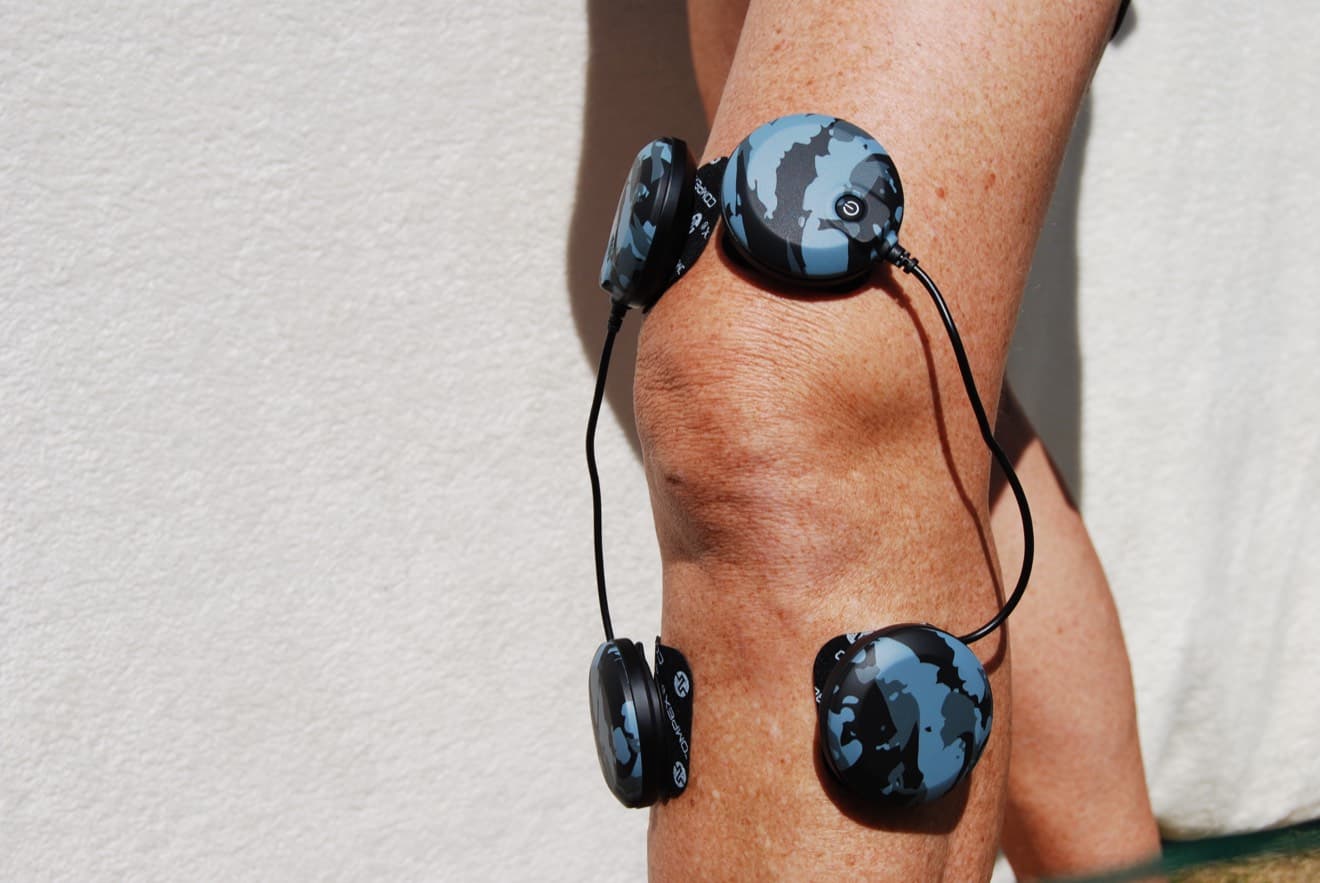
Don't be surprised if your thigh feels weak and slow to respond. Swelling and pain cause the quadriceps to partly switch off after surgery, which is another reason to keep swelling down early. In one trial of 66 patients, muscle stimulation started 48 hours after surgery led to stronger thigh muscles at three and a half weeks, and the difference was still there a year later.6 That's the job a muscle stimulator like Compex does, alongside your exercises rather than instead of them.
Weeks 3 to 6: building up
This is when the hard work starts to pay off. Walks get longer, the stiffness eases and you'll rely less on your walking aids.
Keep working on your knee bend. The scar tissue tightens up over the first six weeks, so regular stretching now makes a real difference.1 Some hospitals suggest a static exercise bike from around week four, starting with five to ten minutes at a time.1
Expect the knee to swell more on the days you do more. A cold and compression session after your exercises or a longer walk helps settle it before the next one, which is how our own recovery guide suggests using the NICE1 at this stage.
There are a few rules for this stage. Don't sit with your legs crossed for the first six weeks, and avoid twisting, bending down and reaching up as much as you can.2 Don't sleep with a pillow under your knee either.2
Around six weeks you'll have a follow-up appointment to check your progress. This is also roughly when many people try walking without an aid, if they feel ready.
On driving, the NHS advises waiting at least six weeks after a total knee replacement, or three weeks after a partial one, and only driving once your doctor says you're fit. You need to be able to do an emergency stop without hesitating.2 It's also best to avoid flying for six weeks and long-haul flights for three months.1
Weeks 6 to 12: getting back to normal life
Most people go back to work after about six to twelve weeks, depending on the job.2 A desk job usually comes sooner than physical work.
This is also when hobbies start to come back. Swimming is fine once the wound has fully healed. Front crawl or backstroke kick tend to be more comfortable than breaststroke. Golfers can usually start chipping and putting at around eight to twelve weeks, but it's worth staying off the driving range for three months because of the twisting.1
Keep avoiding heavy household jobs, like vacuuming or carrying heavy shopping, for the first three months.2 And keep stretching: it becomes much harder to improve how far the knee bends after about three months.
The first weeks back at work or back on the golf course often bring a bit of swelling at the end of the day. An evening session with the NICE1 is an easy way to stay on top of it while you build back up.
Three months and beyond
By three months most of the early milestones are behind you, but recovery doesn't stop there. The NHS says it can take several months or longer to fully recover.2
Some things take longer to settle:
- Swelling. The knee and calf can stay swollen for three months or more.1 For longer recoveries, the NICE1 is also available on a monthly subscription, so you can keep using it for as long as you need.
- Warmth. The knee often feels slightly warm for three to six months.
- Numbness. A numb patch on the outside of the knee is common, and a small area often stays numb for good.3
Between three and six months most activities are possible, though running, jumping and contact sports are usually best avoided. Kneeling won't damage the new joint, but wait until your doctor says it's OK, then start on something soft. Some people never find kneeling comfortable, and that's normal too.
When to get help
Most aches and swelling are part of recovery, but some symptoms need checking quickly:3
- Call 999 if you have chest pain, sudden breathlessness, a fast or irregular heartbeat or feel dizzy. These can be signs of a blood clot in the lungs.
- Contact your hospital team straight away if one calf becomes swollen, throbbing, warm or red. This can be a sign of a blood clot in the leg.
- Contact your hospital team straight away if you have a fever or flu-like symptoms with redness around the wound, or if the wound is red, weeping or bleeding.
Recovery after a knee replacement is measured in weeks and months, not days. Patience and steady work on your exercises are what get most people there.
Recovering from a knee replacement?
This article is for information only and isn't medical advice. Always follow the guidance of your surgical team, physiotherapist and GP.
Sources
The small numbers in the article link to these sources.
- Royal Berkshire NHS Foundation Trust — Total knee replacement: advice and exercises following surgery (patient leaflet). royalberkshire.nhs.uk/leaflets/total-knee-replacement-advice-and-exercises-following-surgery
- NHS — Knee replacement: recovery. nhs.uk/tests-and-treatments/knee-replacement/recovery/
- Dorset County Hospital NHS Foundation Trust — Post knee replacement symptom checker. dchft.nhs.uk/leaflets/post-knee-replacement-symptom-checker/
- Liang Z et al. (review of 31 trials) — Cryotherapy for rehabilitation after total knee arthroplasty: a comprehensive systematic review and meta-analysis. Orthopaedic Surgery, 2024;16(12):2897–2915. doi.org/10.1111/os.14266
- Quesnot A et al. (trial of 40 patients) — Randomized controlled trial of compressive cryotherapy versus standard cryotherapy after total knee arthroplasty: pain, swelling, range of motion and functional recovery. BMC Musculoskeletal Disorders, 2024;25:182. doi.org/10.1186/s12891-024-07310-7
- Stevens-Lapsley JE et al. (trial of 66 patients) — Early neuromuscular electrical stimulation to improve quadriceps muscle strength after total knee arthroplasty: a randomized controlled trial. Physical Therapy, 2012;92(2):210–226. doi.org/10.2522/ptj.20110124