
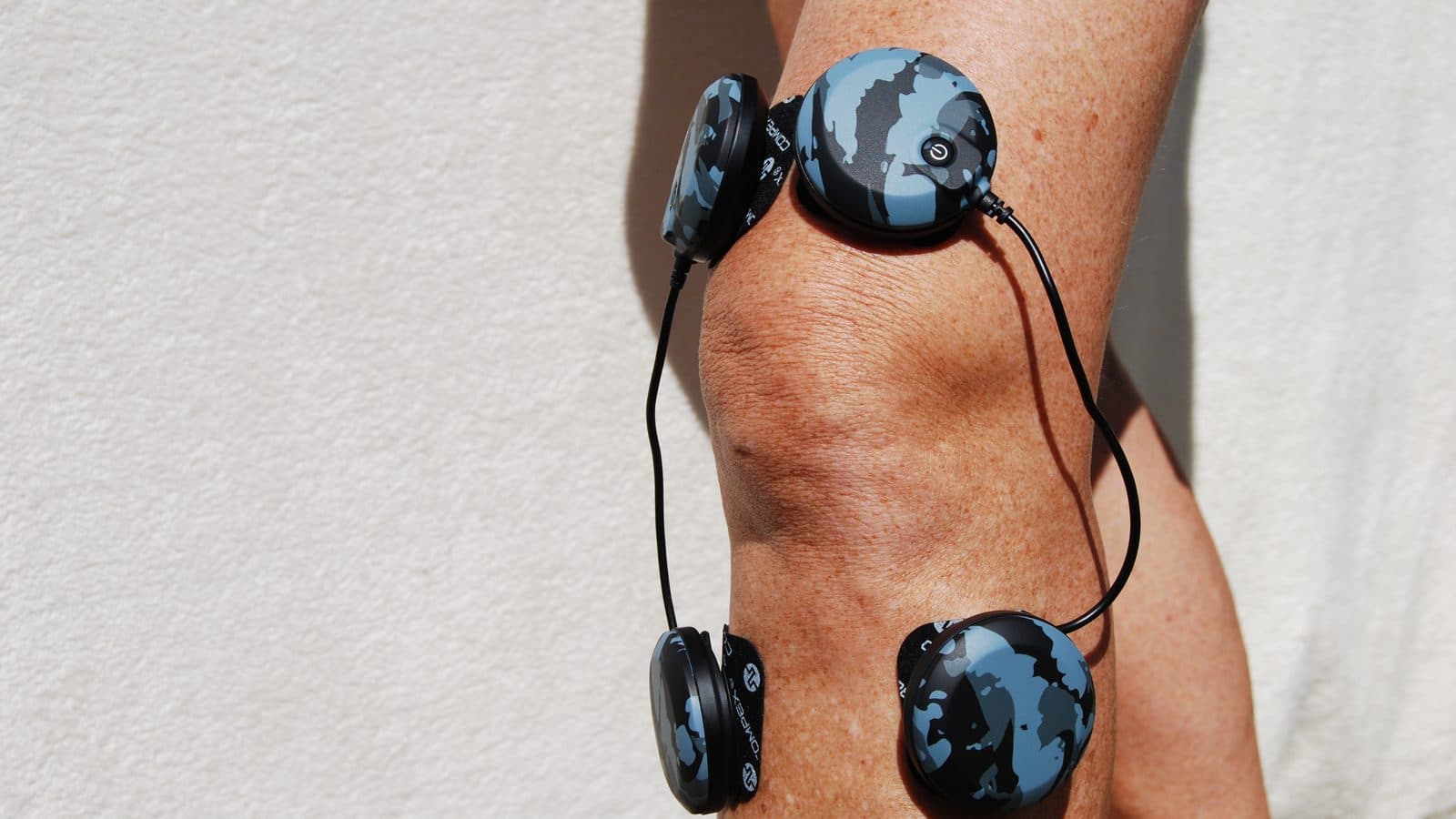
Using Compex After ACL, Cartilage or a Soft-Tissue Knee Injury
Published · by Recovery Kit Team
You can be fit and motivated and still find the front of your thigh won't switch on in the early weeks. Left alone, that strength gap can drag on for months and slow your return to sport.
ACL, cartilage, ligaments — and the hidden problem
Whether you've had an ACL reconstruction, a cartilage or meniscus repair, keyhole surgery, or you're recovering from a ligament or soft-tissue knee injury, you'll likely hit the same wall: your thigh muscle stops firing properly. Just like after a joint replacement, swelling and injury trigger a reflex that holds the muscle back (arthrogenic muscle inhibition). Athletes are often caught out — you can be fit and motivated and still find the front of your thigh won't switch on in the early weeks. Left alone, that strength gap can drag on for months and slow your return to sport.
Compex is one of the best-evidenced ways to tackle it early.
What the research shows
ACL recovery is the best studied. A 2025 systematic review and meta-analysis of 11 randomised controlled trials (402 patients, Orthopaedic Journal of Sports Medicine) found that adding NMES to rehabilitation significantly increased quadriceps strength compared with rehab alone — both in the short term and beyond six weeks (standardised mean differences of 0.53 and 0.59; p<0.001). Crucially, timing mattered: patients who started NMES within the first week saw a far larger effect (SMD 1.48) than those who started later (0.44).
This echoes landmark work by Snyder-Mackler and colleagues (Journal of Bone and Joint Surgery, 1995), which showed high-intensity NMES combined with exercise produced stronger quadriceps and more normal walking mechanics than exercise alone. The same muscle shutdown affects cartilage and other soft-tissue knee surgery, and significant knee injuries once swelling settles, which is why it's used well beyond just ACL cases.
How to use it
Pain relief (TENS). Use the TENS mode in the early phase, including to make rehab more comfortable.
Muscle re-activation (NMES).Early on, use the gentle NMES mode combined with voluntary quad contractions (quad sets) to activate the muscle where there's significant inhibition. For MCL or meniscus injuries in particular, how and when you use it depends on your procedure and any weight-bearing or loading restrictions — but it's genuinely useful for maintaining quad activation and strength during the period your normal loading is reduced.
Strengthening (NMES).As you're cleared to load the knee, integrate the stronger NMES mode with your active strengthening programme, building intensity to the strongest comfortable level. Always as an adjunct to your active rehab, not a replacement.
Why active people rate it
For anyone aiming to get back to sport, it lets you start working the thigh muscle at a stage when your knee can't handle heavy exercise yet — so you're not just waiting and losing muscle. It gives you something productive to do early, and the pain mode supports the harder work that gets you back on the field.
Protect the repair — the one rule that matters most
After soft-tissue surgery, protecting the healing tissue comes first. How hard you push, and when you move into strengthening, must follow your surgeon's timeline — going too early risks the graft or repair. Compex speeds up the strength side of recovery; it doesn't shortcut the healing.
Staying safe
Check you're cleared to start. Don't use it with a pacemaker or other implant, over a wound or numb skin, or if a blood clot is suspected, and never in water. Keep sessions short, build intensity gradually, and use it alongside your rehab.
We hire the Compex SP 8.0 for injury and post-surgical recovery — a simple, evidence-based way to rebuild strength and get back to sport.
References & further reading
- Li Z, Jin L, Chen Z, et al. — Effects of neuromuscular electrical stimulation on quadriceps femoris muscle strength and knee joint function in patients after ACL surgery: a systematic review and meta-analysis of randomized controlled trials. Orthopaedic Journal of Sports Medicine, 2025.
- Snyder-Mackler L, Delitto A, Bailey SL, Stralka SW — Strength of the quadriceps femoris muscle and functional recovery after reconstruction of the anterior cruciate ligament: a prospective, randomized clinical trial of electrical stimulation. Journal of Bone and Joint Surgery (Am), 1995;77(8):1166–1173.
- Recovery Kit — What is Compex, and how does it help recovery?
- Recovery Kit — Lower limb injury: a recovery guide