
What Is Compex, and How Does It Help Recovery?
Published · by Recovery Kit Team
After an operation or an injury, the affected muscles don't just get weaker — they partly switch off. Compex contracts the muscle for you during the exact window it would otherwise be wasting away.
What is Compex?
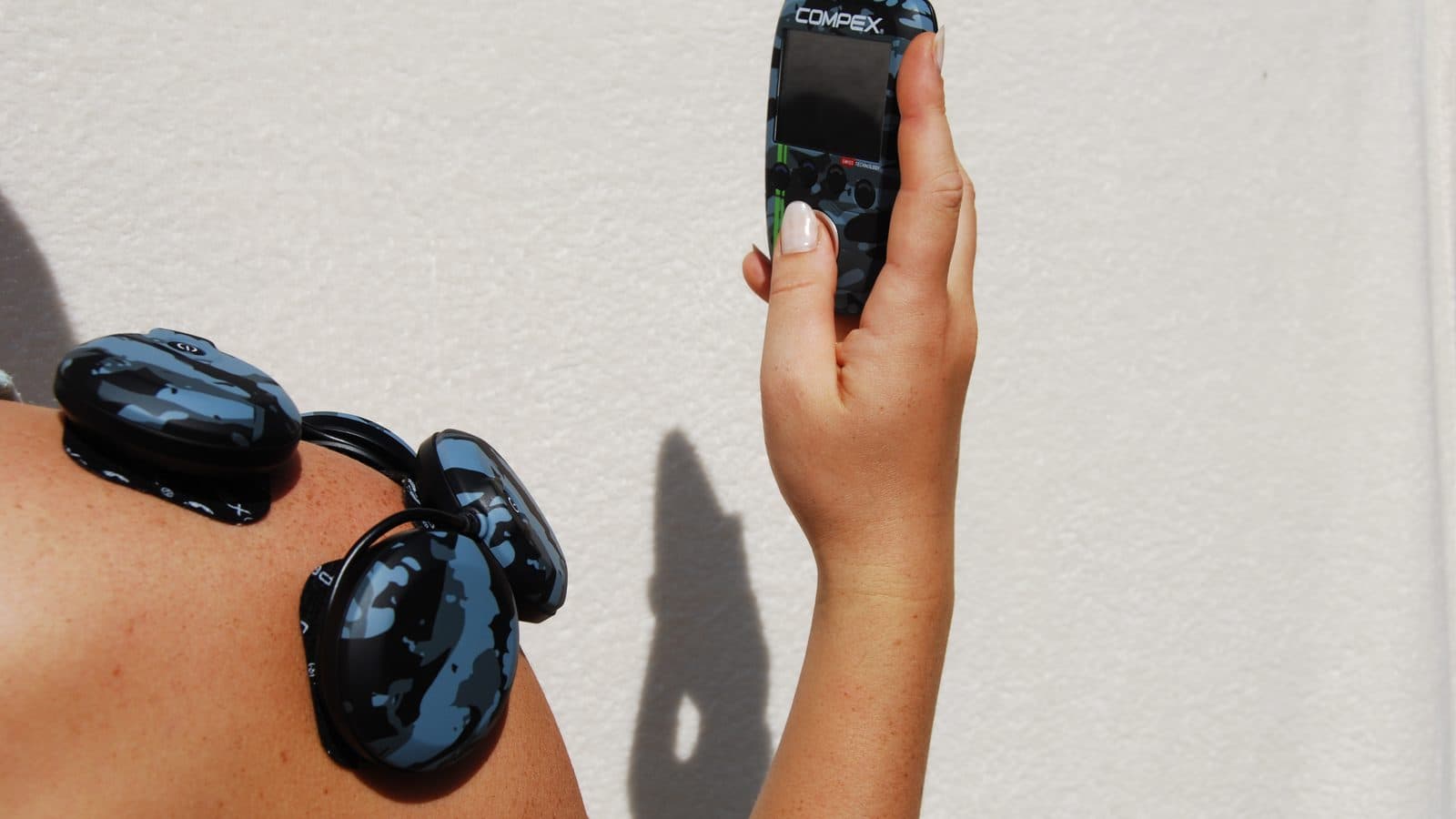
Compex is a small wireless muscle stimulator. You stick pads on the skin over a muscle, and the device sends gentle electrical pulses through them. Those pulses travel along the same nerves your brain normally uses to move the muscle — so the muscle contracts on its own. The clever part is that it works even when pain, injury or surgery has made it hard for you to activate the muscle yourself.
It's used in three clinical ways, so you're never lost in settings. For pain relief, a TENS mode calms pain signals drug-free. For muscle re-activation, a gentle NMES mode contracts the muscle for you so it doesn't waste away. For strengthening, a stronger NMES mode rebuilds the muscle once you're ready to load it. You place the pads, use the mode that fits where you are in recovery, and turn the intensity up to a level that's strong but comfortable.
Why muscles “switch off” after surgery
Here's the key thing to understand. After an operation or injury, the affected muscles don't just get weaker — they partly switch off. When a joint is swollen or has been operated on, a spinal reflex called arthrogenic muscle inhibitionstops you from fully activating the surrounding muscles. So you can try as hard as you can and still recruit only a fraction of the muscle. It's the single biggest reason recovery feels slow, and it's most pronounced in the thigh muscle (quadriceps) after knee surgery.
Compex works around it. Because it acts directly on the nerve, it produces a contraction even when you can't — keeping the muscle active during the exact window it would otherwise be wasting away.
The evidence
The data here is strong, especially around the knee. In a landmark randomised controlled trial after total knee replacement (Stevens-Lapsley et al., Physical Therapy, 2012), NMES started 48 hours after surgery produced significantly greater quadriceps strength and better functional performance at 3.5 weeks, with benefits still measurable at a year. A 2021 meta-analysis in Frontiers in Medicine confirmed improved quadriceps strength at every time point, with the largest effect in the first month — though its authors are careful to note that several of the outcomes they pooled did not reach the threshold for a clinically important difference, so the size of the real-world benefit is still being established. After ACL surgery, a 2025 meta-analysis of 11 trials (402 patients) found NMES added to rehab significantly increased quadriceps strength versus rehab alone — with the biggest gains when started within the first week. And after hip replacement, a 2019 review reported improved knee-extensor strength and muscle size, and in several trials shorter hospital stays and better walking and stair-climbing.
The consistent finding across all of it: Compex works best as a partner to your rehab exercises, and its greatest value is early, when you can't yet do much yourself.
Why patients like it
It gives you something useful to do in the early weeks, when there's little else you can do. The TENS pain mode is a drug-free way to take the edge off. It's low effort at a time when effort is hard. And feeling the muscle contract is genuinely reassuring — proof the limb is still working.
How you use it
Simply, and the same way each time: place the pads where you've been shown, use the mode that matches your stage, and slowly raise the intensity to the strongest comfortable level. Sessions are short — around 15 to 30 minutes. You start with pain relief and muscle re-activation, then move into strengthening as you heal.
In practice, the stimulation is combined with your own voluntary muscle contractions early on — for the knee, doing your quad sets at the same time — then integrated with active strengthening as you progress. It's always an adjunct to active rehab, not a replacement for the exercises.
Staying safe
Check you're cleared to start after your operation. Don't use it if you have a pacemaker or other implant, over a wound, dressing or numb skin, on the front of the neck, if a blood clot is suspected, or if you're pregnant — and never in water or while driving. Used properly and alongside your rehab, it's one of the simplest and best-evidenced things you can add to your recovery.
Recovering from surgery or an injury? We hire the Compex SP 8.0 — a simple, evidence-based way to keep your muscles working while you heal.
References & further reading
- Stevens-Lapsley JE, Balter JE, Wolfe P, Eckhoff DG, Kohrt WM — Early neuromuscular electrical stimulation to improve quadriceps muscle strength after total knee arthroplasty: a randomized controlled trial. Physical Therapy, 2012;92(2):210–226.
- Peng L et al. — Effect of neuromuscular electrical stimulation after total knee arthroplasty: a systematic review and meta-analysis of randomized controlled trials. Frontiers in Medicine, 2021;8:779019.
- Li Z, Jin L, Chen Z, et al. — Effects of neuromuscular electrical stimulation on quadriceps femoris muscle strength and knee joint function in patients after ACL surgery: a systematic review and meta-analysis of randomized controlled trials. Orthopaedic Journal of Sports Medicine, 2025.
- Strengthening quadriceps muscles with neuromuscular electrical stimulation following total hip replacement: a review. Current Physical Medicine and Rehabilitation Reports, 2019.
- Recovery Kit — Using Compex after knee replacement surgery
- Recovery Kit — Using Compex after ACL, cartilage or a soft-tissue knee injury