
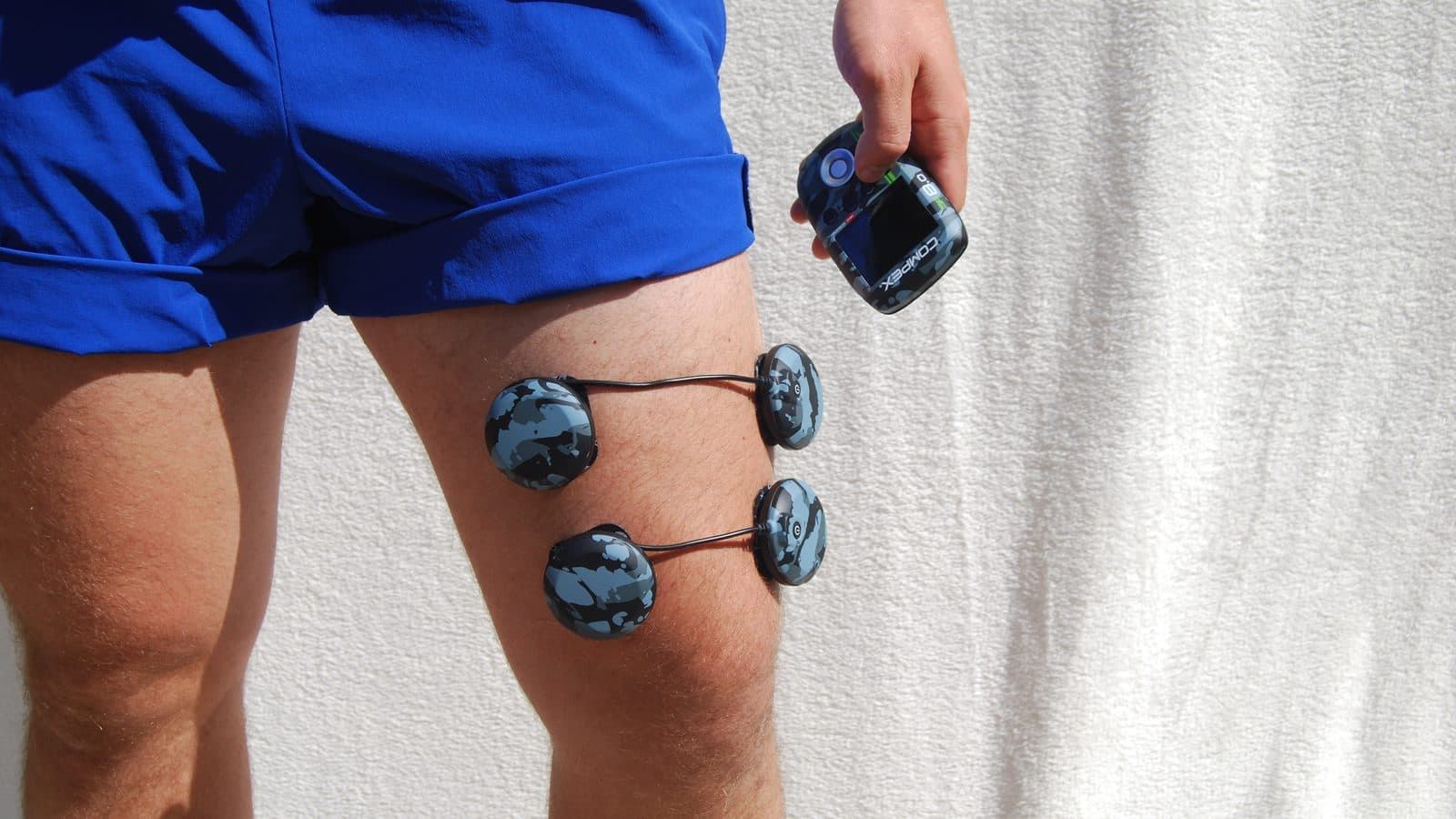
Using Compex After Knee Replacement Surgery
Published · by Recovery Kit Team
The thigh muscle doesn't just get weak after a knee replacement — it partly switches off. That is the main reason the first few weeks feel like slow going, and it is exactly what Compex is designed to address.
The thigh muscle is the key
If one thing decides how fast you recover from a knee replacement, it's the thigh muscle at the front of your leg — the quadriceps. It straightens your knee and controls it when you walk, climb stairs and stand up. After surgery this muscle doesn't just get weak; it partly switches off. Swelling and trauma around the new joint trigger a reflex called arthrogenic muscle inhibition, which holds the muscle back, so even trying your hardest you can't fully use it. This is the main reason the first few weeks feel like slow going — and it's exactly what Compex is designed to address.
What the research shows
Knee replacement has the strongest evidence base for muscle stimulation. In a landmark randomised controlled trial (Stevens-Lapsley et al., Physical Therapy, 2012), 66 patients started NMES just 48 hours after surgery, twice daily at the maximum tolerable intensity. The NMES group had significantly greater quadriceps and hamstring strength, better functional performance and improved knee-extension range at 3.5 weeks — and those benefits were still significant at 52 weeks.
A 2021 meta-analysis of randomised trials in Frontiers in Medicine backed this up: NMES improved quadriceps strength at every time point measured, with the largest effect in the first month (SMD 0.81, still significant at a year), plus better Timed-Up-and-Go scores and around 28 metres more on a 3-minute walk test. Its authors add an honest caveat worth repeating — several of the pooled outcomes did not reach the threshold for a clinically important difference, so the scale of the everyday benefit is still being established. Across the trials, though, the pattern is consistent: start early, use it most days, push the intensity.
How to use it
Pain relief (TENS). In the early weeks, use the TENS mode whenever you need it, including to make your exercises more comfortable.
Muscle re-activation (NMES).Early on, Compex is particularly useful for quad activation when there's significant inhibition. Use the gentle NMES mode together with voluntary quad contractions — squeezing the thigh muscle yourself (quad sets) at the same time as the stimulation — to drive the muscle back on.
Strengthening (NMES). As you progress and are cleared to load the leg, integrate the stronger NMES mode with your active strengthening programme, building the intensity to the strongest comfortable level. Throughout, treat Compex as an adjunct to your active rehab — it works alongside the exercises, never instead of them.
What it will and won't do
Be realistic. Compex is excellent for rebuilding and re-activating the thigh muscle. It won't, on its own, improve how far your knee bends or straightens — that comes from your movement exercises. It's a powerful, evidence-backed partner to your rehab, not a replacement. The people who do best use both together.
Staying safe
Check you're cleared to start after surgery. Put the pads on the thigh as you've been shown, not across the front of the new joint. Don't use it with a pacemaker or other implant, over the wound, on numb skin, or if a blood clot is suspected — and never in the bath or shower. Keep sessions short and build the intensity up gradually.
We hire the Compex SP 8.0 for recovery — a simple, well-evidenced way to tackle the thigh-muscle weakness that slows knee replacement recovery.
References & further reading
- Stevens-Lapsley JE, Balter JE, Wolfe P, Eckhoff DG, Kohrt WM — Early neuromuscular electrical stimulation to improve quadriceps muscle strength after total knee arthroplasty: a randomized controlled trial. Physical Therapy, 2012;92(2):210–226.
- Peng L et al. — Effect of neuromuscular electrical stimulation after total knee arthroplasty: a systematic review and meta-analysis of randomized controlled trials. Frontiers in Medicine, 2021;8:779019.
- Recovery Kit — What is Compex, and how does it help recovery?
- Recovery Kit — Knee replacement recovery: what the science says about cold & compression